Showing posts with label globalisation. Show all posts

Friday, 18 March 2022

News of the World

The last half  century has been pretty much downhill for democracy. As a child I was regularly made aware that we were living in a ‘free country’ with little notion of what that meant, having never known any other. English born we knew we were part of a great tradition of fighting against despotism and tyranny and throwing off first our own yokes and then those of the oppressed people of Europe. Twice. We had the vote, it was the swinging sixties and nothing was going to stop us; we were backing Britain, the greatest nation on what we knew of Earth.

The seventies brought their own tribulations, but a sense of indignation at the power-drunk unions drove us to exercise our democratic rights to vote against such over-arching control. And by the end of that troublesome decade the optimism had returned, at least for those of us who were educated, agile and mobile. Sure the mill towns and pit towns were in decline and the stench of de-industrialisation hung in the northern city air, but we were encouraged by the future that beckoned.

Closing our dark, satanic mills would benefit us all, we were told; let the free market reign and move all that toil and sweat and smoke and lung disease elsewhere. This way we could buy our precious ‘consumer goods’ for increasingly low prices and enjoy the leisure time freed up for us by clever politicians and clever business leaders. Relax, buy property, invest, let the money make money. In time, nobody would need to graft because the good times were just around the corner. The global economy was a force of nature, and a force for good, we were told. And so what if you didn’t, or couldn’t work? The system had the capacity to provide

But there was something wrong, something indecent about importing brown people to drive the buses and staff the corner shops, while the industrious little yellow people from far away made our toys and TVs and our takeaways. We stopped making things and instead let others make them in distant, sunny lands, which is where our money also went. There was no longer a feeling of proud nationhood, of belonging, but instead a note of desperation began to creep in as we moved into the new century increasingly detached from how our country worked.

Because globalisation, just like any other system, might work if it was part of a mix, if it was controlled and ordered by those who depend on it. Except it is not controlled at all and it is ordered, or rather ordained, by people who think they know far better than we how our lives should be lived. This is how we live now, unsure of who controls what, who owns what and from whom we should take direction. The globalists are not in control but are instead the acolytes of forces they have unleashed over which nobody has true dominion.

But it is fine, they say, the rule of law will ensure fairness. Oh, really? Did you see what P&O just did? In a move which has astonished and rightly enraged even free-marketeers, they have torn up contracts and made staff redundant. Redundant? Only by redefining that very word can you sack somebody and immediately replace them with cheap agency staff in those allegedly ‘redundant’ roles. You would think there would be some international law being broken here – I mean the Human Rights lot object even to people being misgendered these days – but the lawyers appear eerily silent. P&O did it simply because they can.

The influencers, the clever finance people, the globalists have created a storm they think they can weather, but for how long? Opening the Pandora’s box of blameless money, of guilt-free exploitation of resources and people, is an act that simply cannot go without consequences. The world of imaginary wealth, where somebody can almost literally think themselves rich, has to end somewhere. When all the little people propping up the pyramid have no option but to leave, where does that leave the globalists?
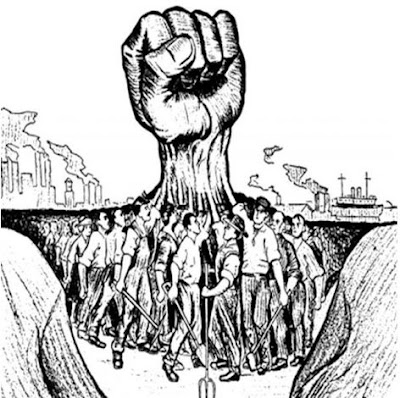
What happened to all this?
Some say restorative justice is the way; let perpetrator and victim meet and talk it out. But others, will settle for nothing less than revenge. The stolen, squandered wealth may not be able to be restored, but this doesn’t mean that reparation is impossible. Let the oligarchs, the mandarins, the money-grubbing industrialists and the exploiters of the workers tremble in fear for the rest of their days. Because when people without any power get angry – and they are as mad as hell right now – they have no other recourse than to violence. It’s coming; you just know it is.

Friday, 18 December 2020

On Greasy Poles

In a rare moment of collusion, several colleagues and I chatted this morning about the state of our industry. Structure, people, education and other resources came into play as we swiftly put the world to rights; standard Friday morning fare, really. Without needing to know which industry it is you will nevertheless recognise the symptoms:

Massive waste as projects are embarked on with no chance of success (everybody on the ground floor knows this.) A complete failure to consult the people who eventually must carry out these grand designs, which are inevitably abandoned at some late stage in proceedings. (Everybody on the ground floor could have told them this) Apprentice schemes that completely fail to meet the needs of the industry, which is more, and better quality people on the ground floor.

Enormous salaries are paid to consultants and industry bigwigs who have abandoned honour and contact with the grass roots to climb the greasy pole to self-aggrandisement. Theirs is a world of meetings and self-congratulatory conferences and award ceremonies as they slap each other on the back even as they burn £100 notes. Like most forms of governance the bureaucracy itself soon displaces the original purpose. Once that promotional ladder has been ascended, they live as if in the halls of Valhalla, glibly making pronouncements which affect the daily lives of millions.

A classic symptom of this kind of thinking is the new boss who wants the entire workforce to do things they have been doing for years, but differently. And I’m not talking about paradigm shifts in client-contractor relationships, or customer-facing skills. Nor am I talking about the introduction of new and better technologies, systems or approaches. It could be as simple and pointless as making everybody fill in a form which achieves nothing and is simply filed away forever, to be shredded at some far distant date. You’ve all been there.

Of course, nobody is suggesting that all industries become collectives, seeking shop-floor approval at every turn – we don’t want to go back to the sixties and seventies, now, do we? But at some tipping point the move away from consultation and cooperation will have dire consequences. It really can’t carry on like this forever; please say it can’t.

Globalised business operates on the Ponzi-like system that more and more lower-paid operatives, churning out more and more product achieves profits based solely on economies of scale. But the recipients of those slim pay packets can’t afford the product and the displaced workers the products are aimed at are no longer employed. Ultimately the companies are not valued at what they are worth in any material sense, but merely as what they – and their handful of grossly overpaid figureheads - are perceived to be worth. Today.

Tomorrow, the market sentiment changes and the whole lot crumbles. Market leaders disappear into financial statistics and the same old money men - the people selling blankets and shovels to the globalist gold rush - become that little bit richer. And those who used to be the bedrock of industry, the skilled workers, are back on their arses again. Little wonder then, that those who can, move into positions of influence, and away from positions of productivity. By those who can, I definitely do not mean the best of the workforce, because it seems a dreary predictability that those with the least amount of utility at the bench are destined for stardom on the board.

The old adage: those who can, do; those who can’t teach is all too often augmented nowadays by the knowing punchline “…and those who can’t teach, manage”. The world will not be shaped anew by the Elon Musks and the Jeff Bezoses, nor by the lofty forums involved in world economics. The answers aren’t with the demagogues but with those of us who do… and those of us who teach how to do. Most of us already see the greasy pole climbers for the vainglorious popinjays they are and reject their abstract indulgences. One day, maybe, we all will.

Wednesday, 10 July 2019

Elite

Oh, the old globalist conspiracy reared its head again recently, although I expect the job of the conspiracy theorists is never just part time; more of a mission than a one night stand. The ‘global elite’ goes the trope, seek to keep us in poverty. Really, they seek to keep us in poverty do they; why would they do that? Surely they would be far better elite global conspiracists if they sought to make us just wealthy enough that we don’t whine about it and dangled just enough gewgaws in our acquisitive little faces that we kept recycling that wealth and in the process made themselves all the richer still.

But such logic can never surface above the film of envy which cloaks every leftists manifesto for their perfect world, filled with perfect humans who never want more than they need. But think about it, really, if your serfs are happy and fed they are less likely to agitate too strongly for change. What would and does make all of us poorer, however, is an insistence on a nebulous, unobtainable ‘equality’ which seeks to restrict those who do better and advance those who don’t. When every little setback is given its own special place in the pantheon of grievance we end up punishing thrift and rewarding indolence and fraud.

Conspiracy? We don’t need conspiracy when so many people have brains hard-wired to see injustice and conclude, therefore, it must be Tory injustice. People being killed off by austerity? Deliberate policies to punish people for falling ill? Seriously, you think that Tories (spit that word, son, spit it) actually, deliberately, wish to cause people harm? Wish to push people into needing expensive treatment which they then deny them? How sick must your mind be to come up with stuff like that? And in any case it’s what you would denigrate as ‘Tory types’ who will foot the bill; it always is. (And you can bet it isn’t Tories who are currently defrauding universal credit recipients to the tune of millions.)

If you want a simpler theory, here’s the evolution-versus-divine-creation comparison: What if making everybody wealthier made the rich wealthier still? What if, people actually having money to spend better serves the globalist ambitions than keeping them in poverty? Steal from people and soon they have nothing left to steal [give a man a fish]. Or allow people to amass spending power of their own and let them buy stuff from you forever [teach him to fish]. Which is the more likely? Which is the least trouble? Which of them requires the least amount of collusion and contorted conspiracy?


Meanwhile we keep on researching poverty and in doing so introduce ever more measures to tell people how badly done by they are when we should be explaining to them how to best participate in the only economic model that has ever really worked – western capitalism - a system in which output has increased 100-fold, work days have been halved and lifespans doubled in the last two hundred years. But all this is wasted on those who would rather wallow in grievance and believe the world is set against them. Now, excuse me, as I must go and skin another poor person for the pot.

Friday, 17 August 2012

Power to the People! (a short story)

As always, it started with a simple enough idea. Hal and Mel were not natural entrepreneurs, far from it. Indeed they’d spent the better part of their post-university years effectively living on handouts. Handouts from the state in the form of various benefit payments-du-jour. Handouts from the public for sitting on street corners, often with a small dog, a sign and an arsenal of three-chord tricks. Handouts from absent homeowners in whose dwellings they squatted, always fully intending to maintain them but somehow letting them fall into what the cynical might call disrepair.

It wasn’t for want of trying; Hal, after all, had a degree in Ecology, Biodiversity and Conservation but following a three-year, gap-year had signally failed to find employment that suited his rigorous ethics. He had once decided to set up a landscape gardening business, but without a driving licence, or start-up capital to purchase a van, or any inclination to offer his services to the vile capitalist scum who might be able to afford them, the business plan foundered within the time it took to finish the pint that had inspired the notion.

Mel, on the other hand had once worked ‘for the man’. To supplement his meagre student grant – meagre because his parents were accountants and grants were means-tested – he had held down several part-time jobs during his time at university. Initially studying Economics he had decided after two years, probably quite correctly, that the world would be a better place without more economists and transferred to read Political Philosophy.

There is, of course, only one political philosophy that anybody actually studies, so after two more years and many drunken nights he had emerged, blinking into the new dawn of a greedy world, a fully paid-up and unashamed Marxist. Back in the early eighties it was an important credential for any Union job in the fight against the imagined tyranny of the Thatcher government. Of course, in order to take up a union job he would actually need to join a union and thus risk the round-the-clock surveillance of MI5. He hadn’t read 1984 for nothing, so turned instead to fight the good fight from the underground, which was, coincidentally, where he met Hal, competing for a prime busking spot.

Rivalry had blossomed into grudging respect and eventual friendship and by the end of the decade of greed, during which their peers had embarked on careers, bought houses and raised happy families, Hal and Mel were finding their feet as regular participants of the fringe protestation industry. Since those early beginnings they had banned bombs, freed basset hounds, marched on Downing Street and fought side by side at the Third Battle of Newbury to the unexpectedly unvoiced gratitude of the thousands who daily endured the misery of the A34’s inadequate transit of the town.

In fact it could be said that the Newbury bypass was Hal and Mel’s road to Damascus, for it was here that Healthy Manna was formed. Feeding the five thousand or more protesters under the constant gaze of the world’s media was no mean task and the opportunistic invasion of greasy capitalist catering vans was anathema to the ethically intense and mostly vegetarian denizens of the tent city.

Rapidly running out of Quorn™ sausages for the makeshift barbecue it was Mel who suggested he was willing to scout for more and headed to an outlying branch of Iceland with the proceeds of a whip-round. On his return with the entire shop supply (five packs) and much more change than he’d expected he found the barbecue abandoned and the protesters engaged in a pitched battle with the police. HM’s first profit nestled snugly in Mel’s pocket.

From there it was a small logical leap to attend the protests ‘going equipped’, with farmers’ market-bought stock selling at captive audience retail prices. Healthy Manna became a fixture at any respectable placard-waving events; Hal and Mel’s guerrilla credentials ensured a healthy turnover and raised fists of solidarity greeted them at every venue.

Inevitably the economic imperatives brought forth competition, but now Mel was in his element. For the first time in his life he actually understood this shit! Incorporation, expansion and diversification; suddenly it all made perfect sense. The brand acquired a killer, new-age logo and within a few short years a fleet of state-of-the-art catering trucks brought wholesome hippy provender to festivals, sporting events and marches alike.

To keep costs down and thus feed their happy-hippy followers within the tight budgets of their state-gifted incomes they sourced ever cheaper ingredients from increasingly dubious sources while tacitly maintaining their ethical credentials and ‘right-on’ unwritten mission statement. They were the people’s caterers, but before long, a decision had to be made.

Prosper or perish? No contest. The corporate world welcomed the launch of HM Plc in the heady days of the new millennium and soon they became a global brand with outlets on every city street corner. Anti-corporate sympathisers the world over willingly donned Healthy Manna tee shirts and HM made millions on the sale of merchandise alone.

Hal & Mel were applauded for not having sold out themselves – even though their accountants had skilfully managed to dispose of their shares and any liability in the company, converting their former holdings into multi-million-pound offshore tax-exempt funds – and they still attended as many radical interventions as time allowed. In fact their main reason for selling up was to achieve a better, more wholesome, work-protest balance. Two weeks in Antigua, a week on the picket lines. Fight the good fight.


And so it was that Hal and Mel, painted urban warriors and protest gods in monster 4x4s, arrived in October 2011 to Occupy St Paul’s Square. As their personal staff erected the tents they wandered off to the nearby H&M Plc Solidarity CafĂ©. With grande choca-mocha-capa-lattes in hand, they paused for a moment under the clenched fist logo and raised their cups in a toast. “Cheers comrade!” said Hal, “Now let’s go and smash the capitalist running dogs!”